
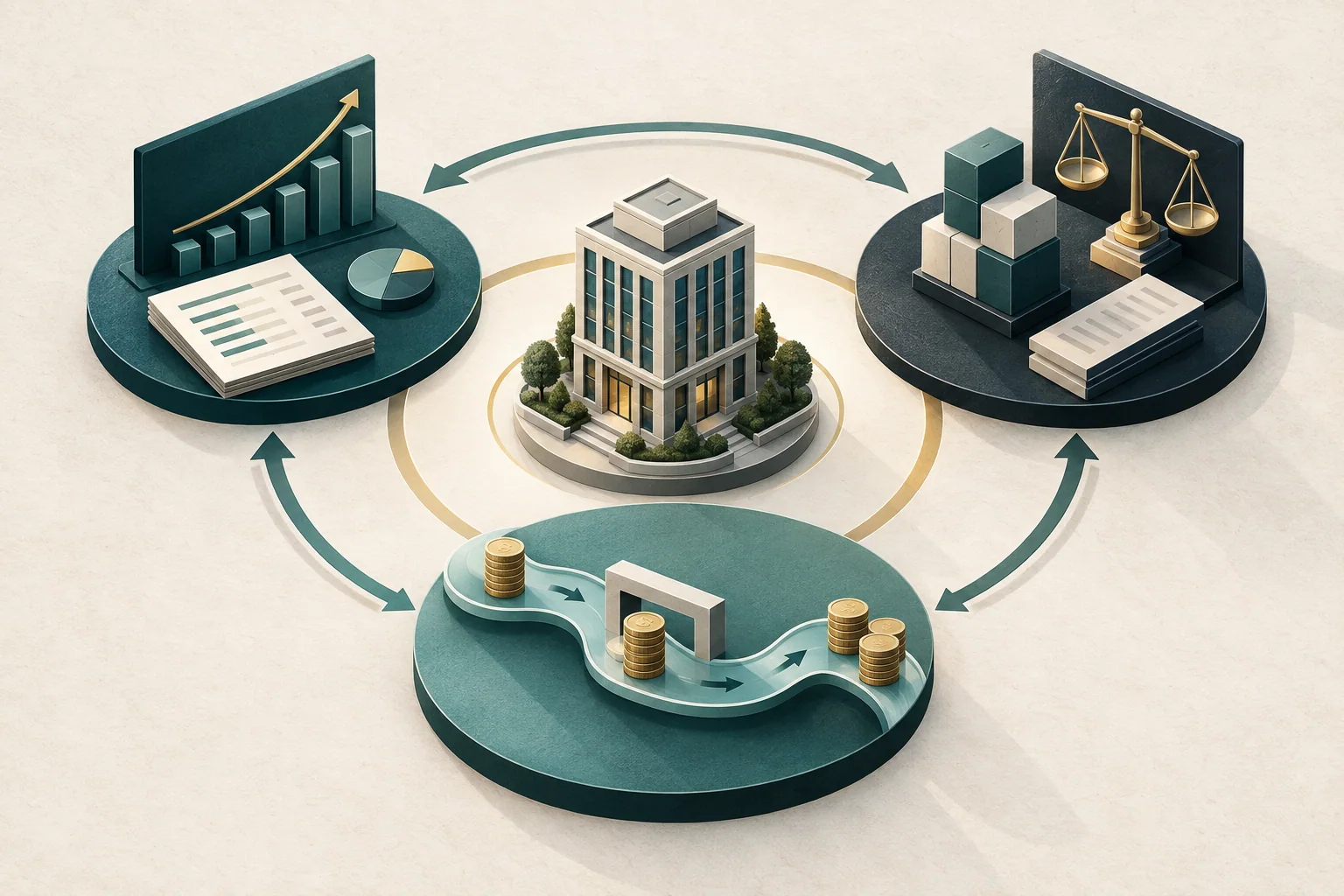
The income statement, balance sheet, and cash flow statement describe the same business from different angles. Reading one statement in isolation can hide important changes. Reading all three together helps an investor distinguish accounting profit from cash generation and understand how growth affects the company’s financial position.
This guide explains the purpose of each statement, the links between them, and a repeatable way to review them in a company’s annual report.
1. The income statement measures performance over a period
The income statement reports revenue, expenses, and profit during a quarter or year. It answers a basic question: did the company earn an accounting profit from the activity recorded during the period?
A simplified sequence is:
- Revenue
- Minus cost of revenue equals gross profit
- Minus operating expenses equals operating income
- Adjusted for interest, taxes, and other items to reach net income
Margins make the statement easier to compare across time. Gross margin can reveal changes in pricing, product mix, or input costs. Operating margin also reflects overhead and operating efficiency. Net margin includes financing, taxes, and non-operating items.
Revenue recognition and non-cash expenses mean net income is not the same as cash received. That is why the other statements matter.
2. The balance sheet is a financial snapshot
The balance sheet reports what the company owns and owes at a specific date. Its central relationship is:
Assets = Liabilities + Shareholders’ Equity
Assets include cash, receivables, inventory, property and equipment, investments, goodwill, and other resources. Liabilities include payables, debt, lease obligations, deferred revenue, and other claims. Equity is the residual interest after liabilities are deducted from assets.
For investors, the balance sheet helps answer:
- Does the company have enough liquidity?
- How much debt must be refinanced or repaid?
- Is inventory or accounts receivable growing faster than sales?
- How much of the asset base consists of goodwill or acquired intangibles?
- Has share issuance materially increased equity and diluted owners?
3. The cash flow statement explains changes in cash
The cash flow statement groups cash movements into operating, investing, and financing activities.
- Operating activities begin with profit and adjust for non-cash items and changes in working capital.
- Investing activities include capital expenditures, acquisitions, and purchases or sales of investments.
- Financing activities include borrowing, debt repayment, share issuance, repurchases, and dividends.
The ending cash balance should reconcile with cash reported on the balance sheet. Operating cash flow also provides the starting point for estimating free cash flow.
How the three statements connect
The statements are connected through many recurring relationships:
- Net income from the income statement enters the operating section of the cash flow statement.
- Ending cash from the cash flow statement appears on the balance sheet.
- Capital expenditures use cash and increase property and equipment on the balance sheet.
- Depreciation reduces income without an immediate cash payment and reduces the carrying value of long-lived assets over time.
- Credit sales increase revenue and accounts receivable before cash is collected.
- Borrowing increases cash and debt; repayment reduces both.
- Net income generally contributes to retained earnings, while dividends reduce retained earnings and cash.
A simple example
Imagine a company records a sale but allows the customer to pay later. Revenue and profit may appear on the income statement immediately. Accounts receivable rises on the balance sheet. Because the cash has not arrived, the increase in receivables reduces operating cash flow.
Now imagine the company buys equipment. Cash falls and property and equipment rises on the balance sheet. The purchase appears as a capital expenditure in investing cash flow. The full cost usually does not reduce profit immediately; depreciation expense is recognized over the asset’s useful life.
These links explain why a growing, profitable company can still consume cash.
A practical review order
- Read the income statement to identify the direction of revenue, margins, and profit.
- Compare net income with operating cash flow.
- Review working-capital changes, especially receivables, inventory, payables, and deferred revenue.
- Examine capital expenditures and acquisitions.
- Check the balance sheet for liquidity, leverage, and obligations.
- Review the notes for accounting policies, debt terms, stock compensation, and unusual items.
- Repeat the comparison across several years rather than relying on one period.
Use this process alongside our 10-K checklist and the broader fundamental stock research framework.
Common mistakes
- Treating net income as cash. Accrual accounting records some activity before or after the related cash movement.
- Ignoring working capital. Receivables and inventory can absorb substantial cash during growth.
- Looking only at total debt. Maturity dates, interest rates, leases, and cash reserves also affect risk.
- Assuming every adjustment is recurring. Compare management’s explanations with the statements and notes.
- Using a single year. Cycles, acquisitions, and temporary disruptions can distort short periods.
Sources and further reading
- SEC: Beginner’s Guide to Financial Statements
- Investor.gov: Researching Investments
- SEC EDGAR Company Filings
Educational content only. This article is not investment, tax, or legal advice. Investing involves risk, including possible loss of principal.
Continue your research
Turn individual metrics into a complete investment process. Use our step-by-step framework to connect business quality, financial statements, risk, and valuation.