
Prepared November 15, 2026. This is a pre-earnings checklist, not a report of Q3 results or a stock-price forecast.
NVIDIA’s next earnings report presents two different questions: how the operating business performed, and how investors should assess a leadership transition after the quarter ended. Keeping those questions separate makes the results easier to interpret.
When are the results due?
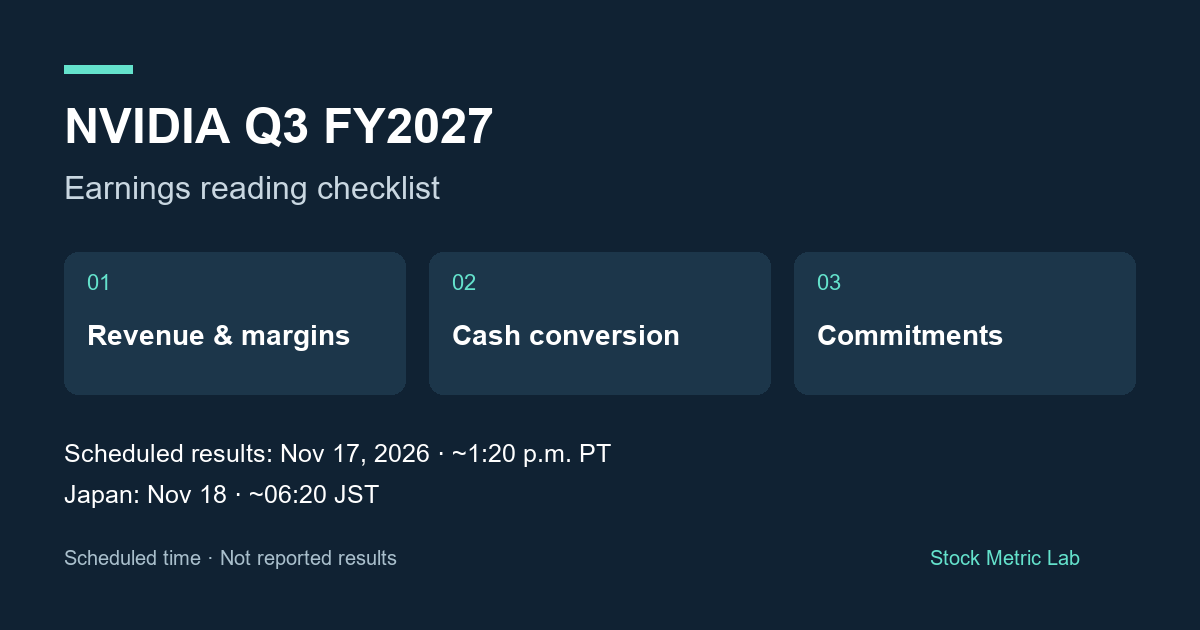
NVIDIA has scheduled its Q3 fiscal 2027 results for November 17, 2026, at approximately 1:20 p.m. Pacific Time, followed by its earnings call at 2 p.m. Pacific. In Japan, those times are approximately November 18 at 06:20 and 07:00 JST. The reporting quarter ended October 25, 2026. These are scheduled times, not confirmation that results have been published. Official earnings notice
The starting point: reported results versus company guidance
| Measure | Q2 FY2027 reported | Q3 FY2027 outlook issued August 26 |
|---|---|---|
| Revenue | $96.221 billion | $108.0 billion, plus or minus 2% |
| GAAP gross margin | 75.0% | 74.0%, plus or minus 50 basis points |
| Non-GAAP gross margin | 75.0% | 74.0%, plus or minus 50 basis points |
The Q2 quarter ended July 26. The right-hand column is management’s outlook, not actual results or an analyst consensus. NVIDIA excluded China Data Center compute revenue from that outlook. Its non-GAAP measures now include stock-based compensation, starting in Q1 FY2027, with historical comparisons restated accordingly. Q2 earnings release and definitions
That table establishes a comparison baseline, not a trading signal. A revenue result above an earlier forecast would not, on its own, answer whether future cash-flow assumptions are reasonable.
Three questions for reading the release
1. What changed in the economics, not just the headline?
Start with revenue, then examine the gross-profit dollars that revenue produced. Read management’s explanation of product mix, costs and execution rather than attributing a margin change to a single cause. Compare like with like: GAAP with GAAP, and non-GAAP with the accompanying reconciliation.
A useful worksheet has separate columns for prior-quarter actuals, the previously issued outlook, newly reported actuals and the next outlook. That prevents a strong forecast from being described as already-earned revenue.
2. How much of the earnings became cash?
Check the period heading before comparing cash-flow numbers. A year-to-date operating-cash-flow total is not a single-quarter figure. If calculating a quarter by subtracting earlier year-to-date figures, document that calculation and confirm the definitions match.
Then read working-capital movements alongside the income statement. Receivables, inventory and customer-payment terms can help explain why cash and earnings diverge. A difference is a question to investigate, not automatic evidence of misconduct. Likewise, investment gains should not be mistaken for recurring operating performance.
3. What obligations sit behind the growth?
Look beyond the income statement to purchase commitments, capacity arrangements, guarantees and risk disclosures in the newly issued documents. Ask what is committed, when it is payable, and which assumptions make the obligation economically attractive.
This is a research checklist, not a claim that a particular risk has worsened. Record what actually changed before deciding whether a valuation assumption needs revision.
Governance is a separate, post-quarter event
NVIDIA’s November 12 Form 8-K states that Huang’s resignation took effect on November 11. Colette Kress became interim CEO while retaining her CFO role, and Harvey Jones became board chair. The filing and its attached release do not give a resignation reason. The transition occurred after the October 25 quarter-end and is discussed here separately from the quarter’s operating results. The board’s stated expectation of uninterrupted operations is an expectation, not proof of subsequent performance. SEC filing · Attached announcement
For the call, a practical question is whether management provides specific, checkable updates on execution and decision-making. Avoid filling information gaps with speculation about motives.
Connect the quarter to the long-term thesis
Use our NVIDIA stock analysis for the business-model background. Its financial snapshot is labeled Q2 FY2027; it is not a substitute for the forthcoming Q3 release.
Before the announcement, write down which operating developments would strengthen or weaken your cash-flow assumptions. Afterward, compare the evidence with those criteria. That is more disciplined than changing a long-term thesis in response to a price move alone.
Educational research only. No individualized investment advice, price target or buy/sell recommendation.