
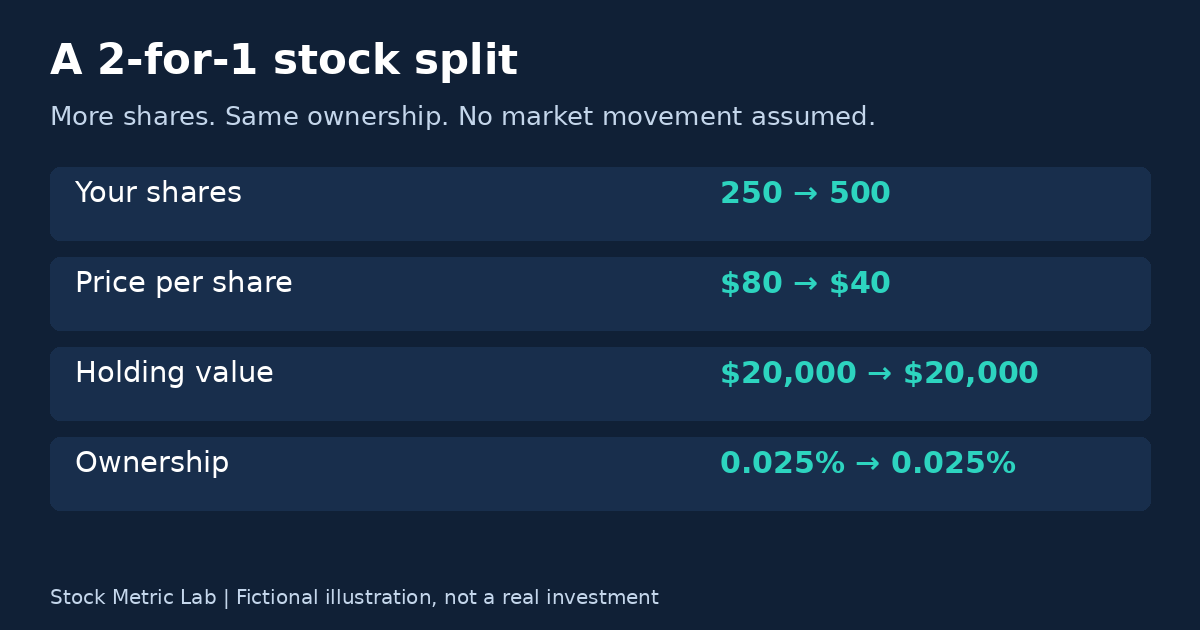
A company may announce a stock split that lowers its quoted price per share while increasing the number of shares. The lower price alone is not a discount or evidence of a loss. This guide explains what a split changes, what stays the same, and how to check the announcement and per-share figures.
A share is a unit of ownership in a company. If that idea is new, start with what a stock is; this guide picks up from there.
The one idea: slices change, the pie does not
A stock split multiplies the number of shares and divides the price per share by the same factor. Nothing else moves at the moment of the split itself — not the company's earnings, not its cash, and not your share of the company.
Fictional example (illustrative, not a real company). Example Co. has 1,000,000 shares outstanding, trading at $80 each. You own 250 of them.
| Before the split | After a 2-for-1 split | |
|---|---|---|
| Shares outstanding | 1,000,000 | 2,000,000 |
| Price per share | $80 | $40 |
| Market value of the company | $80,000,000 | $80,000,000 |
| Your shares | 250 | 500 |
| Value of your holding | $20,000 | $20,000 |
| Your ownership of the company | 0.025% | 0.025% |
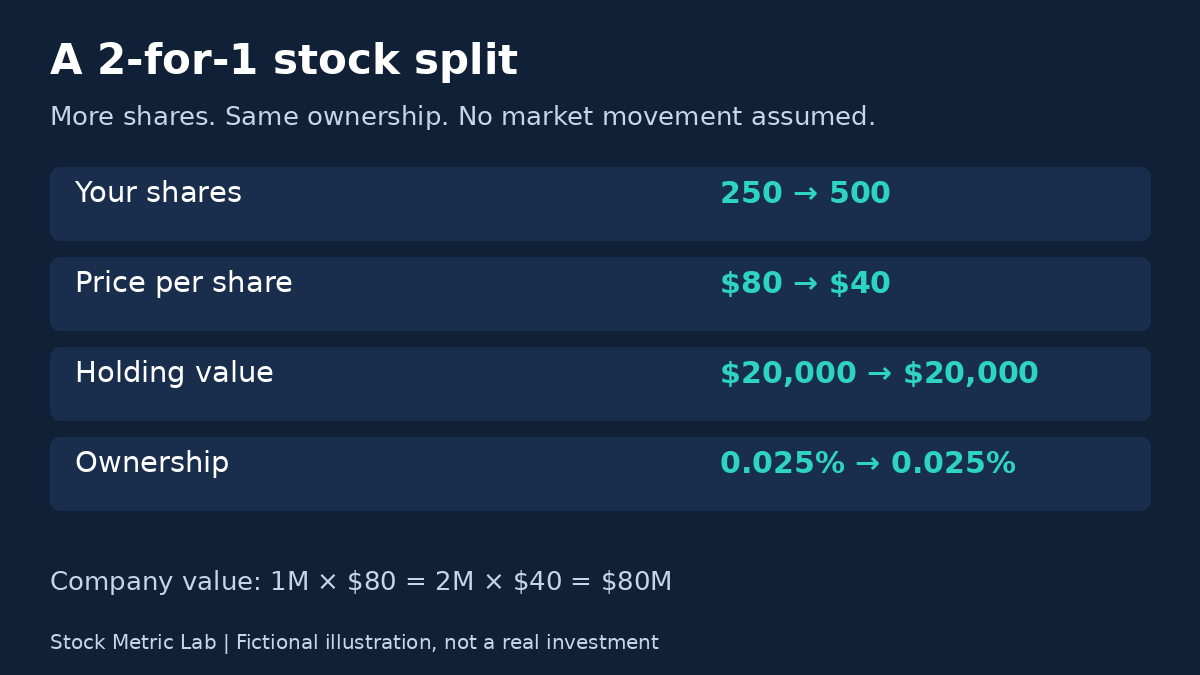
Read the last three rows carefully, because they are the whole point. Your holding is worth the same $20,000 at the moment the split takes effect as immediately before it, and your ownership is the same 0.025% — 250 out of 1,000,000 is exactly the same fraction as 500 out of 2,000,000. The price halved only because the count doubled. That equality is the mechanical adjustment the split itself makes, measured at the moment it takes effect and excluding any market movement: where the price trades in the days after the split is the market's decision, not the split's arithmetic.
Per-share figures halve too, mechanically. If Example Co. earns $4,000,000, earnings per share go from $4.00 to $2.00. If it pays out $1,000,000 in dividends in total, the dividend per share goes from $1.00 to $0.50 — and the total landing in your account is unchanged: 250 × $1.00 = $250 before, 500 × $0.50 = $250 after. A split reshapes every per-share number; it does not change any total.
This is also why a split does not change the company's market capitalisation — price × shares outstanding is the same product before and after. Market cap is covered in depth in the enterprise value guide, where it is the starting point.
Why companies split their shares
If a split changes nothing fundamental, why do it? The practical reason is the price tag on a single share, and what that price tag does to the smallest possible purchase.
- Accessibility. At $80 a share, a small investor saving $100 a month can buy one share and wait. At $40, the same saving buys whole shares sooner and leaves less cash idle. The company is identical; only the entry denomination changed.
- Trading units, including Japan's 100-share unit. For domestic ordinary shares on the Tokyo Stock Exchange, the standard trading unit is 100 shares, so one standard trading unit costs 100 × the share price. Some brokers also offer odd-lot or fractional services. A fictional illustration: at ¥3,000 a share, one unit costs ¥300,000; after a 2-for-1 split to ¥1,500, one unit costs ¥150,000. The minimum ticket halves, even though the company is the same size. This is one reason large Japanese companies with high share prices split their shares.
- Keeping prices in a workable range. Very high prices per share make fine-grained buying and selling awkward for everyone, including employees receiving shares. A split brings the quoted price back into a range the market is used to handling.
What a split does not do: it does not make the company cheaper in any valuation sense (the same earnings now sit behind twice as many shares, so the price-to-earnings ratio is unchanged), it does not create cash, and it is not the company "giving" shareholders anything extra. A lower price per share is a smaller slice, not a discount.
Reverse splits: the same arithmetic, run backwards
A reverse split (also called a share consolidation) does the opposite: it combines shares. In a 1-for-10 reverse split, every ten shares become one.
Fictional example (illustrative). Example Co. trades at $0.60 with 10,000,000 shares outstanding — a market value of $6,000,000. After a 1-for-10 reverse split it has 1,000,000 shares at $6.00, still a $6,000,000 company. Your 20 shares become 2 shares; your holding is worth $12.00 before and $12.00 after.
Why would a company do this? Companies state different reasons, and the reason printed in the company's own notice is the one to read — do not assume a single motive. One context in which reverse splits often appear is price-related listing requirements: some exchanges set a minimum share price for a stock to stay listed, and a company trading in cents risks falling below it. The exact thresholds and grace periods differ by exchange and change over time, so check the exchange's current rules rather than relying on any fixed number. The reading skill is what matters here: a reverse split lifts the quoted price without lifting the business. If the reasons the price fell are still there, the higher price by itself fixes nothing — judge the company on the same earnings and cash flow as before, which is the general approach in how to analyze a stock.
Fractions and awkward remainders
Not every split divides every holding evenly. A 3-for-2 split turns 25 shares into 37.5 shares — and that half share has to go somewhere. What happens depends on your broker and the plan's terms: the fractional part may be credited to your account as a fractional share, or paid out in cash (often called cash in lieu). Either way, the value involved is the fraction of one post-split share — small, but worth knowing about so a small cash credit after a split does not surprise you. Reverse splits create fractions more often, because combining shares leaves remainders behind (25 shares in a 1-for-10 reverse split become 2.5 shares).
Not a split: buybacks, dilution and ADR ratio changes
Three other events change share counts or per-share numbers and are easy to confuse with a split. They are different in kind:
- Share buybacks. The company spends its own cash to repurchase shares and the share count goes down. Unlike a split, this is a real use of cash, and the remaining shareholders end up owning a larger percentage of a company that now holds less cash. A split spends nothing and changes no percentages.
- Dilution (new share issuance). The company issues new shares — for cash, for an acquisition, or for share-based compensation. The count goes up, but unlike a split, existing shareholders' percentage goes down, because the new shares belong to someone else. A split raises your share count in exactly the same proportion as everyone else's; dilution does not.
- ADR ratio changes. An ADR (American Depositary Receipt) represents a set number of a foreign company's ordinary shares. Sometimes the depositary changes that ratio — how many ordinary shares one ADR stands for — which changes the ADR's price and count without anything happening to the ordinary shares at all. That is a change in the wrapper, not a split of the underlying stock. The two can also happen together when a company splits, and then two primary documents exist, one for each event. Sony's 5-for-1 split in 2024 is the worked example: Sony's own split notice of May 14, 2024 covers the ordinary shares, which split effective October 1, 2024; the depositary's corporate-action notice (Citibank, the depositary at the time) covers the ADSs — record date September 30, 2024, payable date October 8, 2024 (U.S. Eastern Time) — and states the ratio as 1 ADR = 1 ordinary share, with each ADS holder receiving four additional ADSs, because the ADSs split in the same 5-for-1 step as the shares they represent. The habit to build: read ADR ratios from the depositary, and read splits from the company's notice — they are separate documents because they are separate events.
Reading documents around a split
The most common beginner error is comparing per-share figures across a split without checking the basis of each figure. Read the adjustment note beside each EPS or dividend figure. Convert only amounts explicitly stated on the pre-split basis, using the announced split ratio. Do not adjust figures already restated on the post-split basis. A document's date alone does not establish which basis every figure uses, and different tables in the same document can use different bases.
A short checklist
- Find the ratio and the effective date in the company's own announcement (for example, "2-for-1, effective [date]").
- Multiply your shares by the ratio and divide the price by it; check that your total value is unchanged. If it is not, something other than the split moved the price that day.
- Compare EPS and dividends per share only on a consistent split-adjusted basis. Check the notes first and convert only unadjusted figures.
- If you hold ADRs, check the depositary's program terms for the current ratio — a split of the ordinary shares and a change in the ADR ratio are separate events.
- Then go back to the fundamentals: earnings, cash flow and valuation are exactly where they were before the split.
Placing orders around all of this — market orders, limit orders and lot sizes — is covered in market vs limit orders.
Frequently asked questions
Does a stock split make me money?
Not by itself. Your shares multiply and the price divides by the same factor, so the value of your holding is unchanged at the moment of the split. Prices can move afterwards for ordinary market reasons, but the split itself creates no gain.
Why did the share price drop 50% overnight?
If the company announced a 2-for-1 split, this is the arithmetic above, not a loss: your share count doubled as the price halved. Check your holding's share count before reacting to the price.
Is a reverse split a bad sign?
A reverse split alone is not a verdict on the business. Companies may consolidate shares to address minimum-price listing requirements or for other reasons. Read the reason stated in the company's notice and assess the business separately. The SEC's explanation of reverse splits describes the mechanics and the listing-rule context.
Do I need to do anything when a stock I own splits?
Normally no. The new share count appears in your account automatically around the effective date. The exceptions worth a glance are fractional remainders (which may arrive as cash) and ADR holdings, where the ratio is worth confirming with the depositary.
Can a company split more than once?
Yes. Nothing prevents repeated splits over the years, which is another reason long-run price charts are shown on a split-adjusted basis — an unadjusted chart would show steps down at every split that were never losses.
For educational purposes only. The examples are fictional and are not a recommendation to buy, sell or hold a security.