
Investing foundations: Lesson 1 of 4
A stock represents a small ownership stake in a company. Buying one connects part of your financial outcome to that business and to the price other investors will pay for its shares. You can benefit if the investment does well, but you can also lose money.
This first lesson explains ownership, dividends, and the difference between a stock’s price and an estimate of its value. You do not need an investing account, a paid tool, or any previous knowledge to follow it.
Before committing money, make a simple money plan to connect your goals and dates with bills and unexpected cash needs.
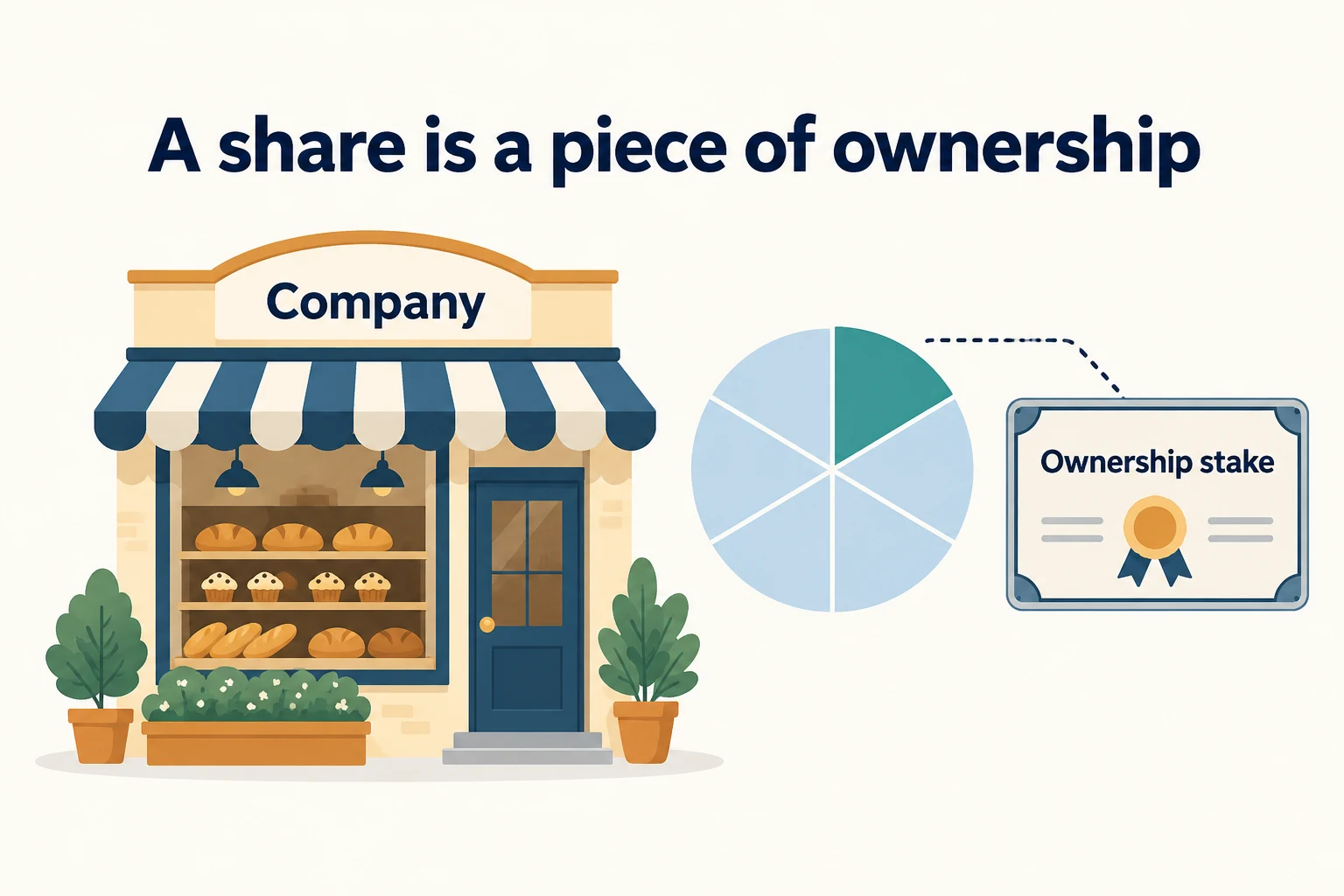
A share is a piece of ownership
Companies divide ownership into units called shares. Stocks are also called equities. When a company issues new shares, it can raise money for activities such as expanding its business. Common shareholders often have voting rights, although rights can differ between share classes. Investor.gov explains stock ownership and share types.
Owning a share does not mean you run the business day to day. You also cannot walk into a company’s store and take goods because you own some of its stock. Your investment is an ownership interest in the company, with the rights attached to that particular share class.
When existing shares trade between investors, the transaction happens in the secondary market. In an ordinary purchase there, your payment goes to the selling investor rather than directly funding a new company project.
Imagine owning part of a bakery
Hypothetical example: River Street Bakery has 1,000 shares, all with identical ownership rights. You own 10. Your stake is 10 divided by 1,000, or 1% of the company. Assume the share count stays unchanged throughout this example.
The bakery sells bread, pays its staff, buys ingredients, and maintains its ovens. If it earns a profit, that profit belongs to the company. Your 1% stake does not automatically put 1% of the year’s profit into your bank account.
Suppose the bakery earns $20,000 and keeps all of it to help replace an oven and develop its business. You still own 1%, even though you receive no cash payment. Whether that spending benefits owners depends on what it achieves.
Now suppose the bakery instead declares a total cash dividend of $5,000. With 1,000 identical shares, the payment is $5 per share. Your 10 shares receive $50. The remaining $15,000 of profit is not an additional payment owed to you.
The company and amounts are invented for learning. Real businesses have more complicated accounts, and these numbers do not describe a typical return.
Dividends and price changes both matter
A dividend is a distribution to shareholders. A common-stock dividend is optional: a company may reduce it, stop it, or never pay one. Another source of investment gains is an increase in the share price. Selling above your purchase price produces a capital gain before costs; selling below it produces a capital loss. FINRA’s stock guide explains both sources of return.
Continue the bakery example. You paid $100 for each of your 10 shares, for a total of $1,000. Later, those shares are worth $1,100, and you have received the $50 dividend in cash. Your investment has gained $150 in total, or 15%, over the period you held it, before any fees or taxes. The length of that period has not been specified, so this is a total return for the example rather than a yearly rate.
Change just one assumption: the shares are now worth $800. Adding the same $50 dividend gives $850, which is $150 below your starting amount. Your total return is negative 15%. A dividend does not cancel every possible price loss.
These simplified calculations combine the change in the shares’ value with cash received. They assume no additional purchases, sales, or dividend reinvestment. If you still hold the shares, their current value can keep changing.
Price and estimated value answer different questions
The market price tells you what buyers and sellers currently agree to exchange a share for. An estimate of value asks what its ownership claim might be worth, considering the business, its future cash generation, and uncertainty. Different people can reach different estimates. FINRA distinguishes market value from estimated intrinsic value.
Imagine two people evaluating the bakery. One expects its new oven to attract more customers. The other expects higher rent and a competing shop nearby. They can agree on today’s share price and disagree about whether it offers good value. Neither person’s estimate is a guaranteed future selling price.
A small price tag alone does not establish a bargain. Suppose Company A has one million shares priced at $10 each. Its market capitalization, the share price multiplied by shares outstanding, is $10 million. Company B has 50,000 shares at $100 each, giving it a $5 million market capitalization. A’s lower-priced share does not mean the whole company has a lower market value. These invented totals say nothing yet about which investment is attractive.
For another simple example, see why a good company can be a poor investment.
Ownership includes the possibility of loss
A business can lose customers, take on too much debt, or fail. Its share price can fall even if it remains open. If a company is liquidated in bankruptcy, common shareholders receive anything left only after higher-priority claims have been met; nothing may remain. The SEC’s stock overview describes this risk.
Knowing a company’s products is a useful starting point. It is only one part of understanding the investment.
Check your understanding
- You own 10 of 1,000 identical shares. What percentage do you own?
Answer: 1%, assuming no change in the total number of shares. - Your shares fall from $1,000 to $800 and pay a $50 cash dividend. Are you ahead?
Answer: No. The shares and received cash total $850, a $150 loss before costs and taxes. - Does a $10 share necessarily offer better value than a $100 share?
Answer: No. Share count, the underlying business, and the price relative to its prospects all matter.
One step you can take without spending money
Write a four-sentence explanation of River Street Bakery for a friend: what you own, how you might receive a return, one way you could lose money, and why price alone does not establish value. Use your own words. If any sentence feels difficult, reread that section.
Next, read Investor.gov’s short introduction to investment risk. Understanding possible losses is part of learning about ownership.
Educational content only, not a recommendation to buy, sell, or hold an investment. Investing involves risk, including possible loss of principal. All worked examples are hypothetical. Sources checked October 11, 2026, Japan time.