
Before choosing an investment, ask what the money needs to do and when you might need it back. A simple money plan helps you identify bills, possible surprises, and questions that still need answers. You can complete this lesson with a notebook and a fictional example. No purchase or account is required.
Start with a goal and a date
A goal gives money a purpose: paying a bill, replacing something essential, or building resources for later life. A time horizon is the time before you expect to need that money. Investor.gov’s goal-setting guidance connects each goal with its time frame.
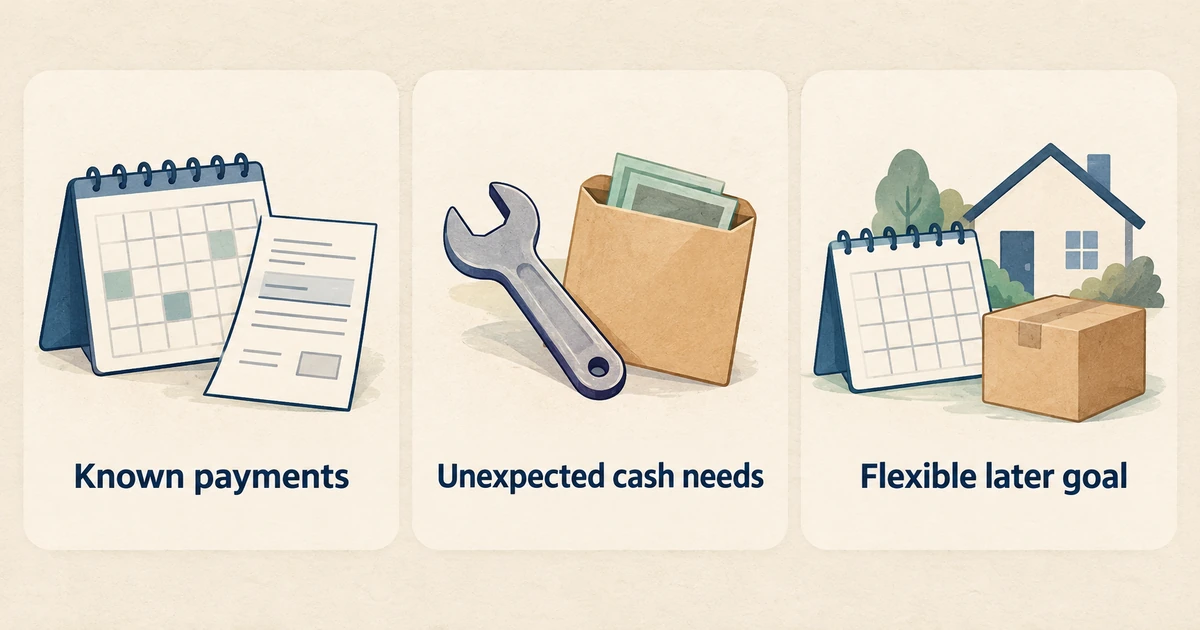
Fictional example: Mina has a required payment due in three months. Mina also wants to build resources for a possible move about ten years from now. The required payment has a fixed deadline. The move could happen later or change in scope. These are separate goals, even if the money currently sits in one account.
For money needed soon, a price decline can become an immediate problem. Selling an investment might produce less than the amount needed for the bill. Investor.gov explains why the date you need money matters. More time may offer flexibility, but it does not guarantee recovery or a positive result.
See the money already spoken for
A balance on a screen does not show every claim on that money. Start with money coming in, ordinary spending, and payments already due. Include essentials such as housing, food, utilities, transport, and required debt payments. Also note predictable expenses that arrive less often, such as an annual bill. Investor.gov’s financial-planning guidance starts with what you own, what you owe, income, and expenses.
Timing matters too. Income arriving after a bill is due cannot cover that bill on time. If earnings vary, a good month alone may give an incomplete picture. These checks help reveal whether money is genuinely available for a longer-term goal. Keep unresolved cash needs visible while learning about investments.
In Mina’s fictional situation, the same displayed balance might have to cover everyday spending, the fixed payment, and an unexpected repair. Writing these needs separately helps expose overlap. A note can show which payments are already expected and which amounts still need to be understood.
Allow for unexpected cash needs
An emergency cash reserve is money set aside for unplanned costs or a loss of income. A broken essential appliance is different from an annual payment you already know is coming. The Consumer Financial Protection Bureau’s emergency-fund guide explains this distinction and says the amount needed depends on the person’s situation.
Consider what a plausible surprise would require: how quickly money would be needed, whether income could stop, and which responsibilities would continue. A suitable reserve depends on these circumstances; one fixed target will not fit everyone.
Emergency money needs to be accessible when the problem occurs. A volatile investment, meaning one whose value can move substantially, might be down when cash is needed. Investor.gov describes that risk for stocks. Check access conditions, withdrawal charges, and any relevant local protections when learning about places to hold cash. Protection, access, and fees vary by product and country.
“Cash” here can include money held in an accessible account. The practical question is how soon someone could actually use it to pay an unexpected bill.
Separate ability from willingness
Investor.gov defines risk tolerance using both ability and willingness to accept investment loss. Consider these separately:
- Willingness: How would someone feel and behave if the investment fell in value?
- Ability, sometimes called risk capacity: What would that loss mean for bills, responsibilities, and the goal itself?
Return to the fictional Mina. Feeling calm about a falling price would not change the payment due in three months. For the flexible move, postponement might be possible, but a loss could still reduce the resources available. Calm feelings cannot remove financial consequences.
The existing investment risk and diversification lesson explains investment risks in more detail. Here, the task is to connect those risks with the money’s job and deadline.
Understand borrowing costs before assuming gains
Interest is a charge for borrowing money. The rate, balance, fees, and repayment terms affect its cost. Investment gains are uncertain; borrowing charges follow the debt’s terms. A hoped-for gain does not cancel an interest charge or guarantee that a payment can be met. Investor.gov highlights high-interest debt as an important issue before investing.
A useful question is: “Do I understand what this debt costs and when payments are required?” Avoid treating an assumed market return and a borrowing rate as equally certain. Different borrowing arrangements have different terms and consequences. Unclear terms are a reason to seek an explanation before committing money.
Write a fictional practice note
Use fictional details only. Keep Mina’s exercise on paper or in a private local note; there is nothing to submit. Copy these five fields:
- Goal
- Needed by, and whether the deadline can move
- Known payments before then
- Unexpected expense the person would need to cover
- Question to resolve before committing any money
One fictional answer: Mina’s goal is the possible move. The date is about ten years away and flexible. Known payments include the required bill in three months and ordinary essential spending. A possible surprise is replacing a broken essential appliance. The unresolved question is whether enough accessible cash would remain for those needs after any investment.
Now change one fact: suppose the move must happen in three months. Rewrite the deadline and the unresolved question. Notice how changing a goal’s timing changes the cash problem without changing anyone’s enthusiasm for investing.
Check your understanding
- Does being comfortable with a price decline make a fixed bill flexible? No. The due date and payment requirement remain.
- Does a longer horizon guarantee recovery? No. More time cannot guarantee an investment’s outcome.
- Must you buy an investment to finish this lesson? No. The completed fictional note is the outcome.
Keep learning while questions remain
Sorting out cash needs or borrowing questions can take time. You can still learn what a stock represents, compare stocks, mutual funds, and ETFs, or practice reading a stock chart without buying anything. A useful next step is one clear question to resolve, rather than pressure to invest immediately. You can also practice how compounding, fees, and inflation affect a fictional investment without committing money.
Educational content only, not personalized financial advice or a recommended investment amount. Investing involves risk, including possible loss of the money invested. All examples are fictional. Sources checked October 12, 2026.