
Investing foundations: Lesson 2 of 4
Investment risk is the possibility that an outcome will differ from what you expect, including losing money. Diversification means spreading exposure across different investments so that one failure has less influence on the whole. It can help manage risk, but it cannot make investing risk-free.
You can learn these ideas before choosing any investment. This lesson uses imaginary businesses and simple arithmetic to show what diversification can do, where it falls short, and why the date you need your money matters.
Risk means more than a moving price
A share price might rise and fall sharply. Those fluctuations are called volatility. They can matter greatly if you need to sell during a decline. But risk also includes a business failing, prices rising faster than your money grows, or difficulty selling an investment when you need cash. Investor.gov outlines these different investment risks.
Consider a hypothetical $1,000 investment now worth $700. The $300 decline is 30%. If you have not sold, the loss in market value is unrealized, but it still affects what your investment is currently worth. Waiting does not guarantee that the price will recover.
Getting back from $700 to $1,000 would require a gain of about 42.9%, because the gain is measured from the smaller $700 starting point. A 30% gain would reach only $910. This is arithmetic, not a forecast of how markets behave.
Taking more risk may offer the possibility of a higher return. It also creates the possibility of worse outcomes. A larger risk is never a promise of a larger reward.
Three imaginary businesses make the idea visible
Hypothetical example: Imagine $3,000 invested entirely in a bakery. A company-specific problem causes the bakery’s shares to lose half their value. Your holding is now worth $1,500.
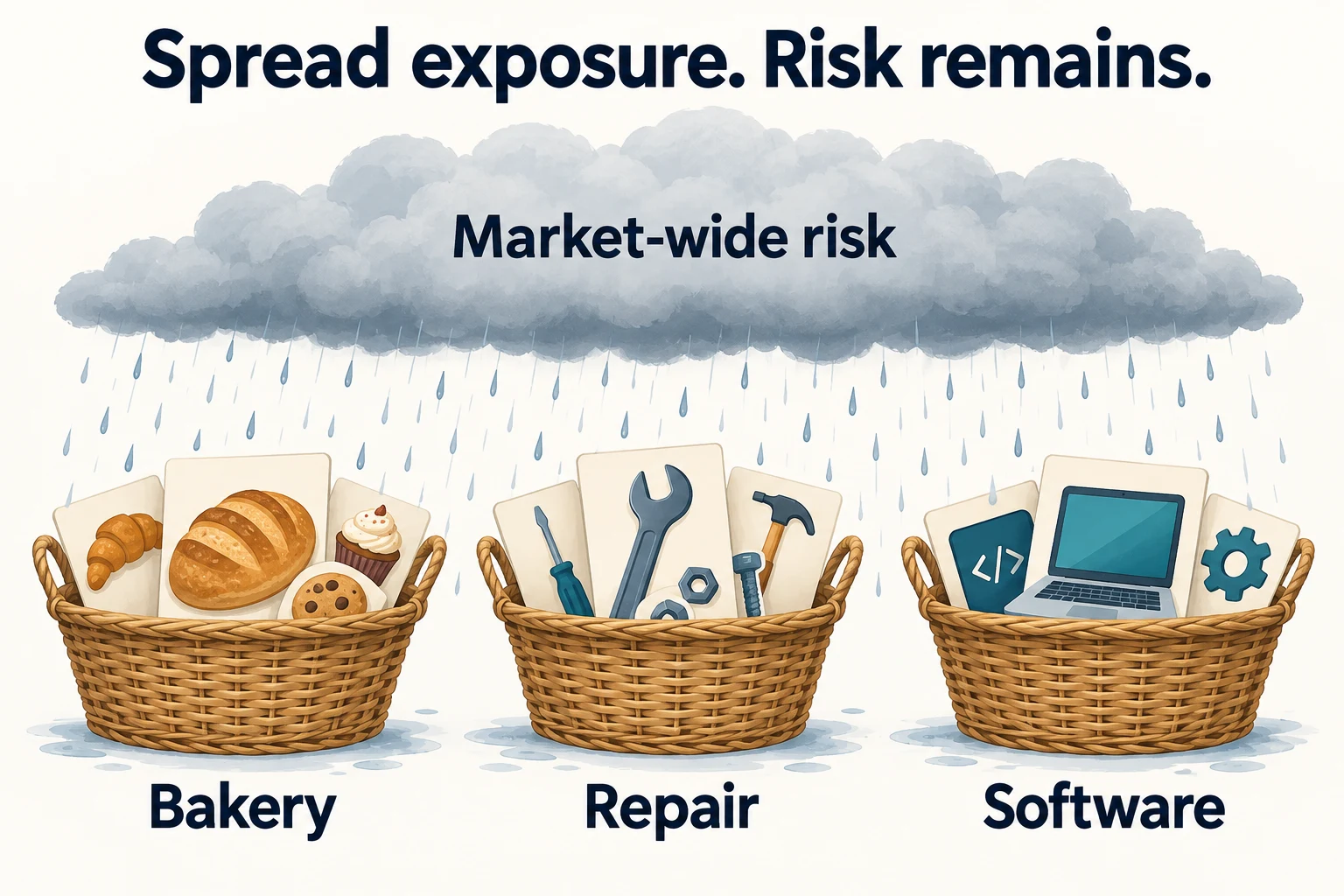
Compare that with a separate example: $1,000 in the bakery, $1,000 in a repair business, and $1,000 in a software business. The bakery falls 50%, while the other two holdings stay unchanged.
- Bakery: $1,000 becomes $500
- Repair business: $1,000 stays $1,000
- Software business: $1,000 stays $1,000
- Total: $3,000 becomes $2,500, a loss of about 16.7%
Spreading the money reduced the damage from this one event. It did not turn the loss into a gain. The unchanged prices are invented assumptions; real businesses will not conveniently take turns losing money.
Now imagine a broad market decline in which all three holdings lose 20%. Each $1,000 holding becomes $800, leaving $2,400 in total. Different company names did not prevent a $600 loss. As Investor.gov’s diversification explanation emphasizes, diversification cannot guarantee protection when markets fall.
These are teaching examples, not a suggested three-stock portfolio or an allocation to copy. Fees, dividends, and taxes are omitted to keep the comparison simple.
Different names can hide the same exposure
A portfolio is the collection of investments you hold. Its diversification depends on what those investments contain and what can affect them together.
For example, owning several restaurant companies may still leave you heavily exposed to higher food costs or weaker restaurant spending. Owning several funds may also mean owning the same large companies repeatedly. A fund pools investors’ money; its name alone does not tell you how broadly it invests. FINRA explains concentration and overlapping holdings.
In the imaginary three-business example, you would want to know whether all three serve the same town, rely on the same major customer, or borrow heavily from the same lender. Counting holdings is a starting point. Understanding shared weaknesses gives the count meaning.
Diversification can involve different companies, industries, regions, and types of assets. Asset allocation describes the mix of asset types, such as stocks, bonds, and cash. The appropriate mix depends on individual circumstances; there is no percentage combination prescribed by this lesson.
If your later question is “How would my chosen limits affect one stock purchase?”, the optional SML Position Size Planner (USD 7) compares cash, chosen loss-budget and concentration constraints in an Excel worksheet. You supply the inputs and limits. It does not assess portfolio-wide diversification, and actual losses can exceed the planned loss.
Your time horizon changes the consequences
Your time horizon is the period before you expect to need money for a goal. Risk tolerance includes both your willingness to accept loss and your financial ability to bear it. Investor.gov explains these concepts together.
Imagine Alex and Sam each starting with $1,000 and experiencing the same $300 decline. Alex needs the money for a fixed bill in six months. Sam’s intended use is many years away and can be postponed. The percentage loss is identical, but the practical consequences differ.
A longer horizon may provide more flexibility through market declines. It does not rescue a failed business or promise a positive return by a particular date. Feeling comfortable with risk also does not mean a near-term bill can wait.
Costs and purchasing power also deserve attention
Fees reduce the money available to earn future returns. In a deliberately simple example, $1,000 with no investment gain or loss becomes $990 after a $10 fee. Diversification does not remove that cost. The SEC’s explanation of investment fees shows why repeated charges matter over time.
Inflation can reduce what money buys even when its displayed balance does not fall. Liquidity describes how easily an investment can be sold; a hard-to-sell holding may prevent timely access to cash or require accepting an unfavorable price. Investor.gov explains liquidity risk. These issues sit alongside market risk rather than disappearing when you own more investments.
To compare an ending balance with what it can buy, practice compounding, fees, and inflation with fictional numbers.
Check your understanding
- Can a diversified stock portfolio fall during a broad market decline?
Answer: Yes. Diversification can reduce some risks, but many holdings can fall together. - Are five funds necessarily more diversified than one?
Answer: No. Their holdings may overlap or focus on the same narrow area. - Does having 15 years guarantee that an investment will recover?
Answer: No. More time may add flexibility, but recovery remains uncertain.
One step you can take without spending money
On paper, describe one imaginary financial goal. Add its deadline, whether that deadline can move, and what a 30% loss shortly before it would mean. This is a way to understand consequences, not a test that assigns you an investment.
Next, read the SEC’s introduction to mutual funds and ETFs to see how pooled investments work.
Educational content only, not personalized investment advice or an asset-allocation recommendation. Investing involves risk, including possible loss of principal. All worked examples are hypothetical. Sources checked October 11, 2026, Japan time.