
Investing foundations: Lesson 3 of 4
A stock gives you an ownership stake in one company. A mutual fund or exchange-traded fund, usually called an ETF, pools money to invest according to a stated plan. Buying a fund gives you an interest in that pool rather than asking you to buy each underlying investment separately.
The distinction helps you understand what you are researching. This lesson explains fund structure, active and passive management, and costs. It does not ask you to choose a product or open an account. The pricing details use U.S. funds as examples; local rules can differ.
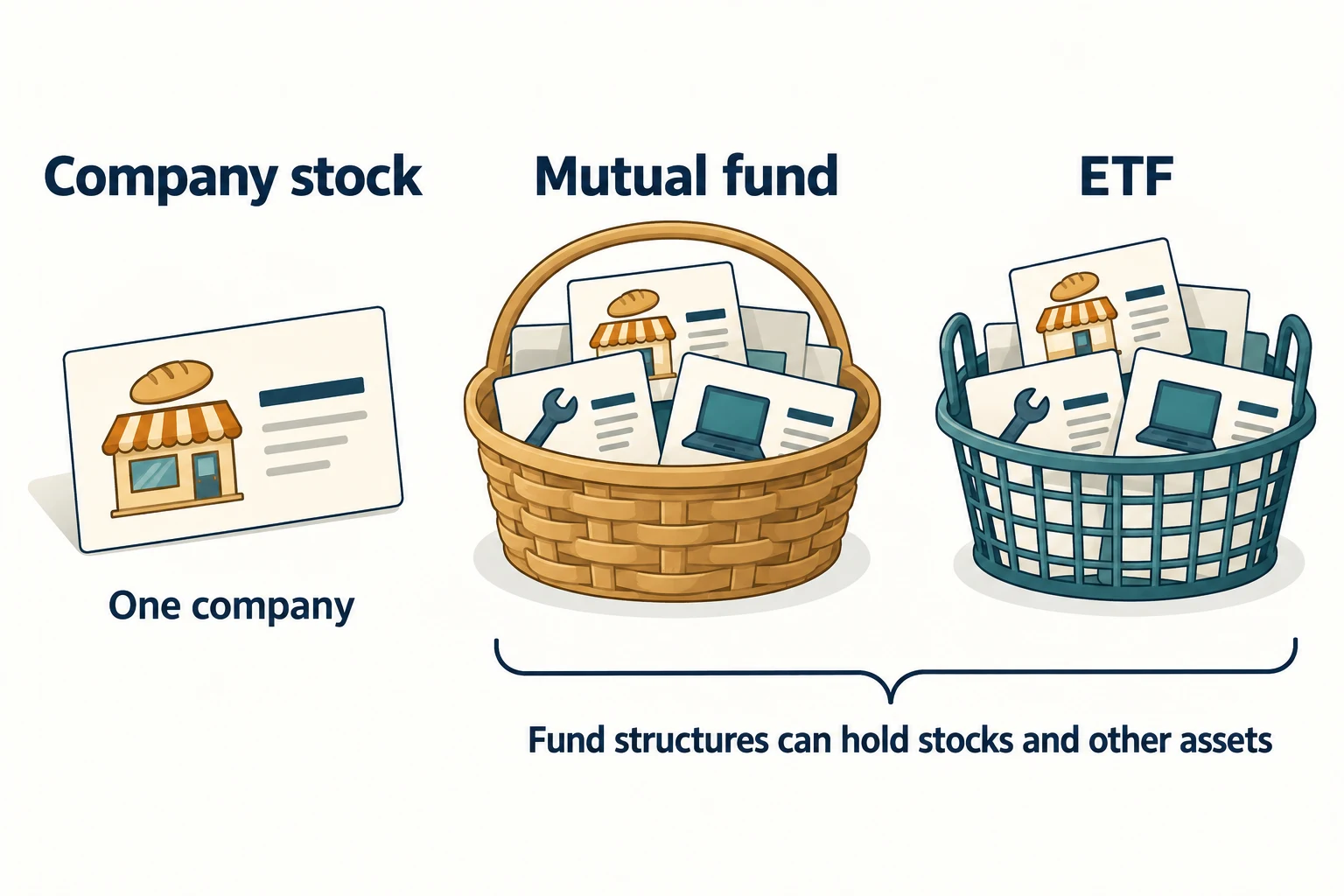
One company or a pool of investments
An individual company stock connects your investment to that company’s prospects and share price. A fund may hold stocks, bonds, or other assets. Bonds are borrowing arrangements: an issuer raises money from investors and promises payments under specified terms. A fund’s collection of investments is its portfolio. Investor.gov explains how mutual funds pool money and hold investments.
Hypothetical example: You are learning about River Street Bakery. One option to study is the bakery’s own stock. Another is an imaginary fund holding shares in the bakery and many other businesses.
In the first case, the bakery is the business behind your holding. In the second, the fund owns the underlying shares, and you own shares in the fund. The fund’s results depend on its holdings, their proportions, its strategy, and costs. A problem at the bakery may have a smaller effect if it is only a small part of the fund, but the whole fund can still lose money.
How a mutual fund is priced
In a typical open-end mutual fund, investors purchase shares from the fund and sell them back to it, sometimes through an intermediary. Orders receive the next calculated net asset value per share, or NAV, with applicable charges added or deducted. NAV is normally calculated once each business day. The SEC compares mutual fund and ETF pricing.
NAV starts with the value of a fund’s assets, subtracts what the fund owes, and divides the result by the number of fund shares. It describes the fund’s net assets per share; it does not promise what those assets will be worth tomorrow. Investor.gov defines NAV.
For an invented example, a fund has $12 million of assets, $1 million of liabilities, and one million shares. Its NAV is $11 per share. Tomorrow’s calculation may differ as its investments and other figures change. Submitting an order in the morning does not lock in yesterday’s NAV.
How an ETF is priced
ETF shares trade on an exchange during the trading day, much like company stocks. Ordinary investors buy and sell at market prices. An ETF also calculates NAV, but its trading price may be higher or lower. A price above NAV is a premium; below NAV is a discount. The SEC’s ETF bulletin explains the distinction.
Suppose an imaginary ETF has an end-of-day NAV of $20 per share and a closing market price of $20.10. That is a $0.10 premium, or 0.5% of NAV. This example explains two different numbers you might see; it does not show a trading opportunity or tell you that the premium will disappear.
The ability to trade throughout the day describes how the product works. It does not require frequent trading.
Active and passive describe the strategy
An index is a measure that tracks a defined group of investments using particular rules. It might represent a broad stock market or a narrow industry. You cannot buy the index itself. An index fund tries to track its performance, using all its holdings or a representative selection. Fees and differences in implementation mean a fund’s return may differ from the index. Investor.gov explains index funds.
This index-tracking approach is commonly called passive management. Active management gives a manager discretion to choose investments within the fund’s stated objective. Both mutual funds and ETFs can be active or passive, as the SEC’s fund comparison confirms.
Imagine a fictional index containing 100 businesses under published rules. One fund tries to follow those rules. Another selects 25 businesses its manager expects to serve its objective. Either strategy could be offered through a mutual fund or an ETF. The structure and the selection process answer separate questions.
A fund label does not establish diversification
An ETF can focus on one industry or even track a single stock. Mutual funds can also be narrowly focused. Several funds may hold many of the same companies. FINRA explains why fund holdings and overlap matter.
For an invented comparison, Fund A holds 100 companies across several industries. Fund B holds 100 companies concentrated in one industry. Their equal holding counts do not mean equal exposure to an industry downturn. Even Fund A might put a large share of its assets in a handful of companies.
Useful questions are what the fund owns, how much its largest holdings represent, and what could hurt several holdings together. A long list of names alone cannot answer them.
Costs go beyond the label
A fund’s expense ratio expresses annual operating expenses as a percentage of its average net assets. Those expenses come out of fund assets. Some funds also have purchase, sale, or account-related charges, and other costs can sit outside the expense ratio. The SEC’s fund-fee bulletin explains where to find them.
For scale, a 0.20% annual expense ratio corresponds to about $2 a year per $1,000, if the amount remained constant. A 1% ratio corresponds to $10. Actual dollar expenses vary with value and timing. These invented rates are examples, not quotes for real funds.
For a worked example of repeated costs, follow how compounding, fees, and inflation change a fictional investment.
For an ETF, also consider any trading commission and the bid-ask spread, the gap between buying and selling quotes. That spread can create a cost even when commission is zero. The SEC describes ETF trading costs. Compare actual disclosures; neither the ETF label nor the word “index” guarantees the lowest total cost.
For the instructions used in exchange trading, explore market and limit orders. Practice the price and execution trade-off without buying anything.
Check your understanding
- Is every ETF a passive index fund?
Answer: No. ETFs and mutual funds can use either active or passive strategies. - Does an ETF with 100 holdings automatically give broad diversification?
Answer: No. Its holdings may share a narrow focus or be unevenly weighted. - Does a 0.20% expense ratio describe every cost of owning and trading a fund?
Answer: No. Trading and other charges may apply separately.
One step you can take without spending money
Draw three columns on paper: company stock, mutual fund, and ETF. Under each, write what you own and how the price is determined. Under the two funds, add “check holdings, strategy, and total costs.” Use the lesson to fill any gaps.
Next, read the SEC’s guide to fund fees, focusing on the fee table in the prospectus. A prospectus is a document explaining a fund’s investment goals, risks, past performance, and expenses.
Educational content only, not a recommendation to buy, sell, or hold an investment. Investing involves risk, including possible loss of principal. Examples are hypothetical. Fund mechanics described here follow U.S. SEC educational sources; rules and products can differ elsewhere. Sources checked October 11, 2026, Japan time.