Arm Holdings reports results for the second quarter of its fiscal year ending March 2027 — the quarter ended September 30, 2026 — on Wednesday, November 4, 2026, after the U.S. close, with a webcast at 2:00 p.m. Pacific Time (5:00 p.m. Eastern; 7:00 a.m. Japan time on November 5). The date comes from Arm’s own October 5 announcement.
Arm is the toll collector of modern computing: it licenses processor designs, then collects a royalty on nearly every chip built on them. Our full Arm stock analysis covers the business model, the valuation question and the SoftBank control structure. This preview is narrower. It is a reading guide for one release: what to check, against which baselines, and what each line would — and would not — prove.
The baselines: Q1 fiscal 2027 (quarter ended June 30, 2026)
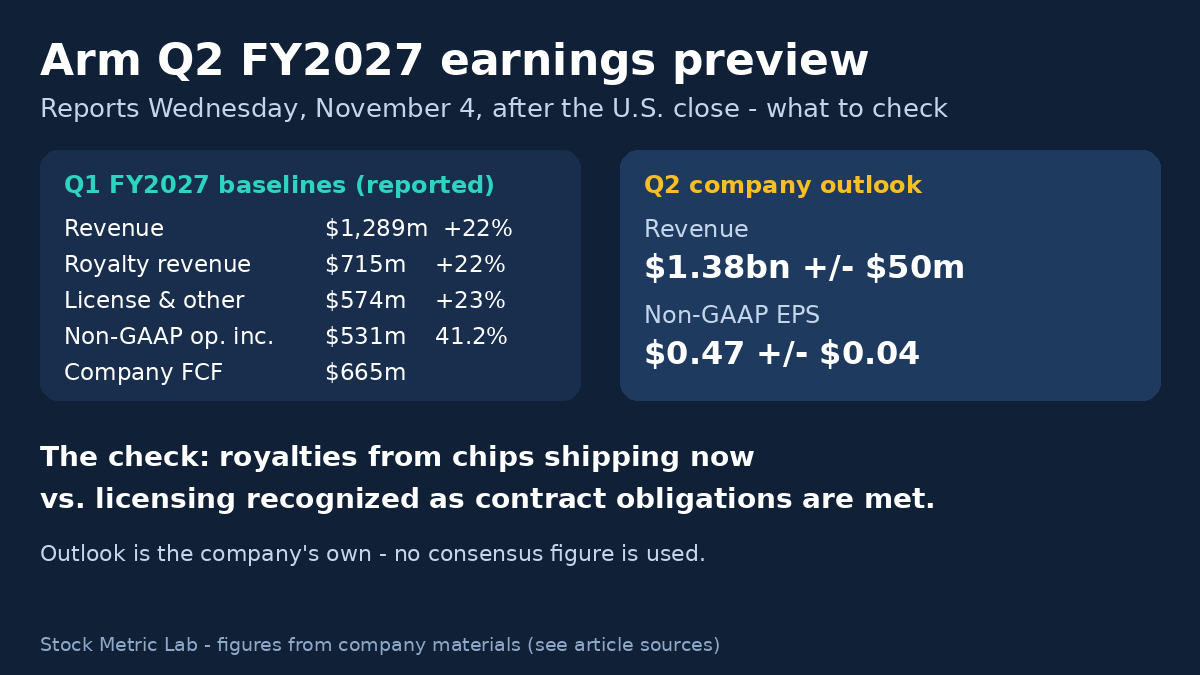
| Line | Q1 FY2027 | Year over year |
|---|---|---|
| Total revenue | $1,289m | +22% |
| Royalty revenue | $715m | +22% |
| License and other revenue | $574m | +23% |
| GAAP gross margin | 97.2% | unchanged |
| GAAP operating income | $91m (7.1% margin) | −20% |
| Non-GAAP operating income | $531m (41.2% margin) | — |
| Company-defined free cash flow | $665m | +343% |
Primary sources for this section: Arm’s Q1 shareholder letter (Form 6-K), from which the outlook below also comes.
Two features of this baseline matter for reading Q2. First, the gap between the GAAP and non-GAAP operating lines includes equity-settled stock-based compensation, related employer taxes and other adjustments. Q1 stock-based compensation was $343 million, about 27% of revenue. The compensation expense and the employer taxes have different cash-flow implications, so the whole gap should not be read as a single “cost of dilution.” Compare margins with peers on the same accounting basis. Second, management itself said Q1’s free cash flow benefited from the timing of receivable collections and tax payments. The $665 million is real, but it is not a run-rate, and the trailing-twelve-month company-defined figure of $1,397 million is the steadier yardstick.
The company’s own yardstick for Q2
Arm’s Q1 shareholder letter set the outlook for this quarter (company outlook, not analyst consensus):
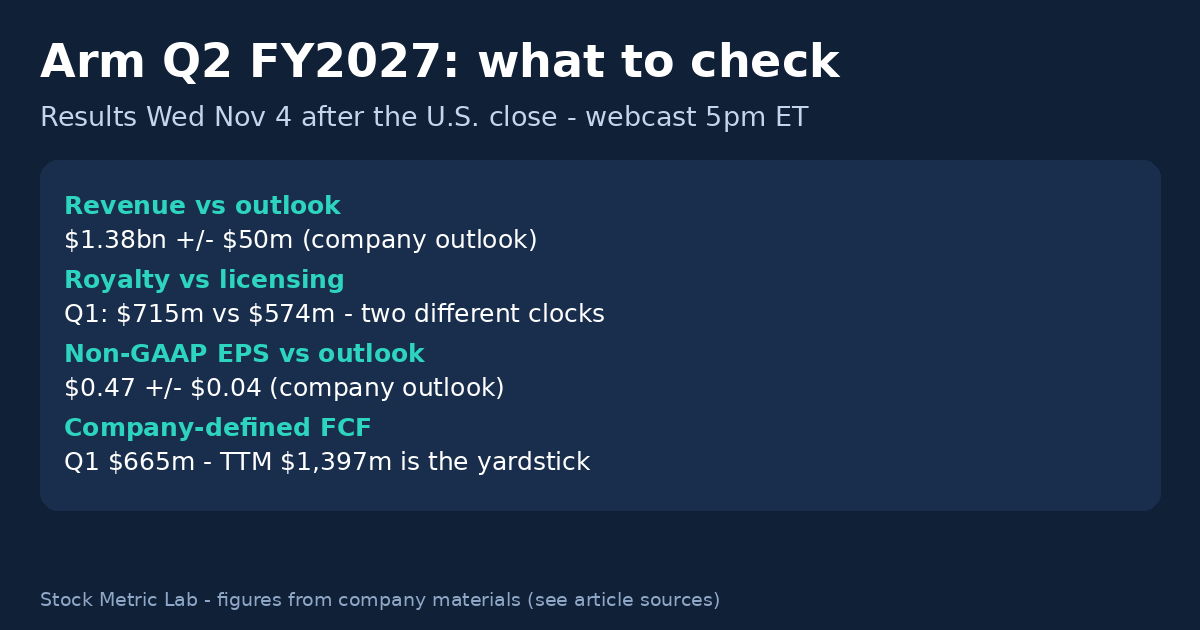
- Revenue: $1.38 billion, plus or minus $50 million
- Non-GAAP EPS: $0.47, plus or minus $0.04
This preview scores the release against those two lines and nothing else. There is no consensus figure in this article, because the company’s own outlook is the cleaner test.
What to check in the release
1. Total revenue against the outlook. A result inside $1.33–1.43 billion means Arm met the yardstick it set. A result outside it is information about the quarter — but read it together with the split below before treating it as a verdict on demand, because Arm’s two revenue lines run on different clocks and a single line can move the total.
2. Royalty versus licensing — the split that matters. Royalty revenue reflects chips shipping now, under designs licensed quarters or years ago. License and other revenue follows the obligations and timing in each contract. Some IP revenue is recognized at delivery or the start of the license term, whichever is later; library access, support and certain services can be recognized over time. Signing and recognition are different events, and recognition can lag signing by quarters, so this line is not a count of what was signed in the period. In Q1 they grew together (+22% and +23%). What would change the read: royalty growth holding up says the installed base is compounding — in Q1, Arm said data-center royalties more than doubled year over year, and whether the letter repeats a data-center royalty disclosure is itself a data point. Licensing is the lumpier line — a single large agreement can flatter or depress a quarter — so a licensing move on its own proves less than a royalty move. Neither line’s growth rate, alone, measures “AI demand”; royalties include smartphones, vehicles and embedded chips alongside data centers.
3. The EPS line, and the GAAP gap behind it. Compare non-GAAP EPS with the company’s $0.47 ± $0.04 outlook, then read the reconciliation. Q1’s operating-income bridge contained $343 million of equity-settled stock-based compensation, $90 million of related employer taxes net of R&D tax incentives, and $7 million of other operating expenses. These adjustments lifted GAAP operating income of $91 million to non-GAAP operating income of $531 million. Equity-settled compensation is a non-cash expense that can dilute shareholders; employer taxes involve cash costs and are not dilution. A wider total gap alone does not measure dilution. Check share counts and the adjustment mix separately. The EPS reconciliation also includes investment-income and income-tax adjustments, so it is not the same as the operating-income bridge. The free cash flow guide explains why compensation added back to cash flow still matters economically.
4. Free cash flow, on the company’s definition, without annualizing. Arm presents its own free-cash-flow measure (operating cash flow less purchases of property and equipment and intangibles, and payments on intangible obligations). Q1 printed $665 million with a timing tailwind management disclosed. Read Q2 together with the trailing-twelve-month trend: does the trailing-twelve-month figure build on $1,397 million, and does management again flag timing effects? A single soft quarter after a flagged-strong one proves little on its own, in either direction: read it by its parts — the timing of collections and tax payments, operating profit, working capital and capital spending — before calling it anything.
5. The AGI CPU — new numbers only. In Q1, Arm said customer demand for its AGI CPU — its first move from licensing designs to selling its own production silicon — exceeded $2 billion across fiscal 2027 and 2028, against roughly $1 billion of manufacturing capacity secured. Demand statements are pipeline, not revenue. The Q2 question is narrow: is there new quantitative disclosure — capacity expanded, a delivery or revenue-recognition timeline, first product revenue? If the letter repeats the Q1 wording unchanged, that is the finding: nothing new to score. Do not treat the $2 billion as booked sales; it is not.
6. The outlook for Q3, as printed. The most durable part of any Arm release is the guidance for the next quarter, given in the shareholder letter itself. Use the checklist below to record it when it arrives. Judge Wednesday’s numbers against the Q2 outlook above; judge the story, afterwards, against the Q3 outlook Arm chooses to set.
One absence to note: Arm did not report remaining performance obligations (RPO) or ATA/AFA contract counts in its Q1 shareholder letter. Whether they return in this release is Arm’s choice. Earlier previews elsewhere may still list them as items to check — if they stay absent, that is a disclosure practice, not a demand signal; if they return, they re-enter the checklist.
Where Arm sits in the cluster
Arm is the design layer of the AI hardware stack this site tracks: TSMC manufactures the chips, memory makers such as SK hynix feed them, test demand reaches Advantest, and the spending itself is tallied in the AI capex comparison. The semiconductor analysis framework sets out how the licensing model’s economics differ from the foundry, memory and fabless models — which is why Arm’s release is read on royalties and licensing rather than on units shipped.
Results-night checklist
- Total revenue against the $1.38bn ± $50m company outlook
- Royalty revenue and license and other revenue, separately
- Data-center royalty disclosure repeated or updated?
- Non-GAAP EPS against the $0.47 ± $0.04 company outlook, alongside GAAP EPS
- Stock-based compensation in the quarter
- Company-defined free cash flow (quarter and trailing twelve months)
- AGI CPU: any new quantitative disclosure?
- Q3 fiscal 2027 outlook as given in the letter (revenue, non-GAAP EPS)
Sources and data cutoff
Prepared on November 4, 2026, before Arm’s Q2 results. Reported figures in this preview refer to Q1 FY2027; Q2 revenue and EPS figures are company outlook, not actual results or analyst consensus.
- Arm Q1 FY2027 shareholder letter and Form 6-K, July 29, 2026: financial statements, non-GAAP reconciliation, revenue-recognition policies and Q2 outlook.
- Arm earnings-date announcement, October 5, 2026: November 4 release after the U.S. market close and the 5:00 p.m. Eastern webcast.
This article is for educational and informational purposes only. It is not investment, financial, tax, legal, or accounting advice, and it is not a recommendation to buy, sell, or hold any security. Verify current filings, ADR terms, tax rules, foreign-exchange rates, and market information before making an investment decision.