
A repurchase announcement gives you a spending limit or a plan, not a complete account of what shareholders receive. To assess it, connect the shares actually bought, new shares issued, the price paid, and the cash available. Higher earnings per share can accompany a good capital decision, an expensive one, or no improvement in the business.
This guide starts with the mechanics and then tests price and financing. All worked examples are fictional and use U.S. dollars. They are teaching scenarios, not estimates of any company’s value or a recommendation to trade.
1 What a buyback changes
A company repurchases its own shares from selling shareholders. An authorization permits purchases within the stated terms. Execution means purchases have actually occurred. A program need not be fully used, and some programs have no stated expiry or fixed maximum. Read the particular announcement.
Start with the issuer’s repurchase disclosure for shares acquired, prices, dates, and remaining authorization. Check cash paid in the financing section of the cash-flow statement, then reconcile it with the equity note. Settlement timing and the disclosure’s treatment of costs can produce differences. The cover-page share count alone cannot tell you how much was repurchased.
Keep three share measures separate:
- Outstanding shares at a date show the shares held outside the company at that point.
- Issued shares can include treasury shares, depending on the presentation. Repurchasing shares into treasury does not necessarily reduce issued shares.
- Weighted-average shares for EPS reflect how long shares were outstanding during the earnings period. Diluted EPS also reflects qualifying potential shares under the applicable accounting rules.
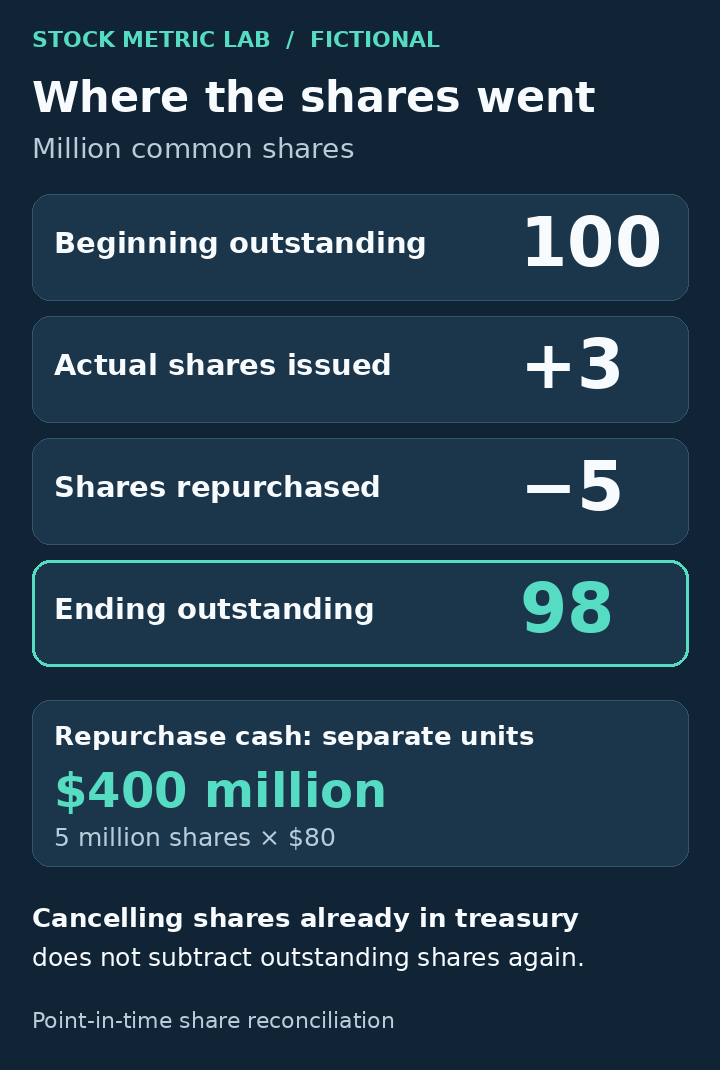
Shares held in treasury are excluded from the outstanding shares used in basic EPS. Cancelling those treasury shares does not remove them from the EPS denominator a second time. Cancellation ends those particular shares, but it does not prevent the company from issuing new shares in future.
For an actual filing example, Apple’s 2025 Form 10-K presents separate disclosures in the cash-flow statement and Notes 3, 10, and 11 for EPS, the share roll-forward, repurchases, and compensation. It illustrates where to look, rather than supplying the fictional numbers below.
2 A buyback with unchanged earnings
Assume annual earnings available to common shareholders of $500 million and 100 million shares, giving basic EPS of $5.00. There are no preferred-share allocations or potential dilutive securities. For the full-year comparisons below, every purchase and issuance occurs at the very start of the year, so each resulting share count is also the full-year weighted-average basic count.
Hold earnings at $500 million to isolate the denominator. This deliberately ignores financing effects, lost interest, transaction costs, and repurchase taxes. The financing section later relaxes the unchanged-earnings assumption.
- Repurchase price: $80 per share.
- Cash paid: $400 million.
- Shares bought: $400 million ÷ $80 = 5 million shares.
- Remaining shares: 100 million − 5 million = 95 million.
- Basic EPS: $500 million ÷ 95 million = about $5.26, an increase of 5.3% using unrounded amounts.
The denominator changed; the assumed profit did not. This calculation establishes EPS accretion under the stated conditions, not value creation.
Timing changes the result. If the same repurchase instead occurs exactly halfway through the year, the weighted average is (100 million × 50%) + (95 million × 50%) = 97.5 million. Annual basic EPS is about $5.13, even though the ending share count is still 95 million. Real filings use the applicable timing and accounting treatment. Do not reconstruct reported EPS with only the year-end count.
A gross buyback yield can put spending in context. Here, $400 million of executed purchases over the illustrated year divided by the $8 billion beginning market capitalization (100 million × $80) equals 5%. This is a stated analytical convention, not a standardized return measure. Other providers may use current or average market value, different periods, or net issuance. Align definitions before comparing companies.
Buying back 5% of the initial shares does not guarantee a 5% investment return. A dividend yield also answers a different question. The dividend guide explains its period and payment assumptions.
3 Reconcile issuance in shares and cash separately
Now suppose the company also delivers 3 million actual new common shares through compensation settlements or option exercises at the start of the year, before buying the same 5 million shares. The $500 million earnings assumption already includes the applicable compensation expense. We are isolating the share-count effect, not treating compensation as free or predicting what the new capital earns.
| Scenario | Weighted-average basic shares | Basic EPS rounded |
|---|---|---|
| No issuance or buyback | 100 million | $5.00 |
| Buyback only | 95 million | $5.26 |
| Issuance only | 103 million | $4.85 |
| Issuance and buyback | 98 million | $5.10 |
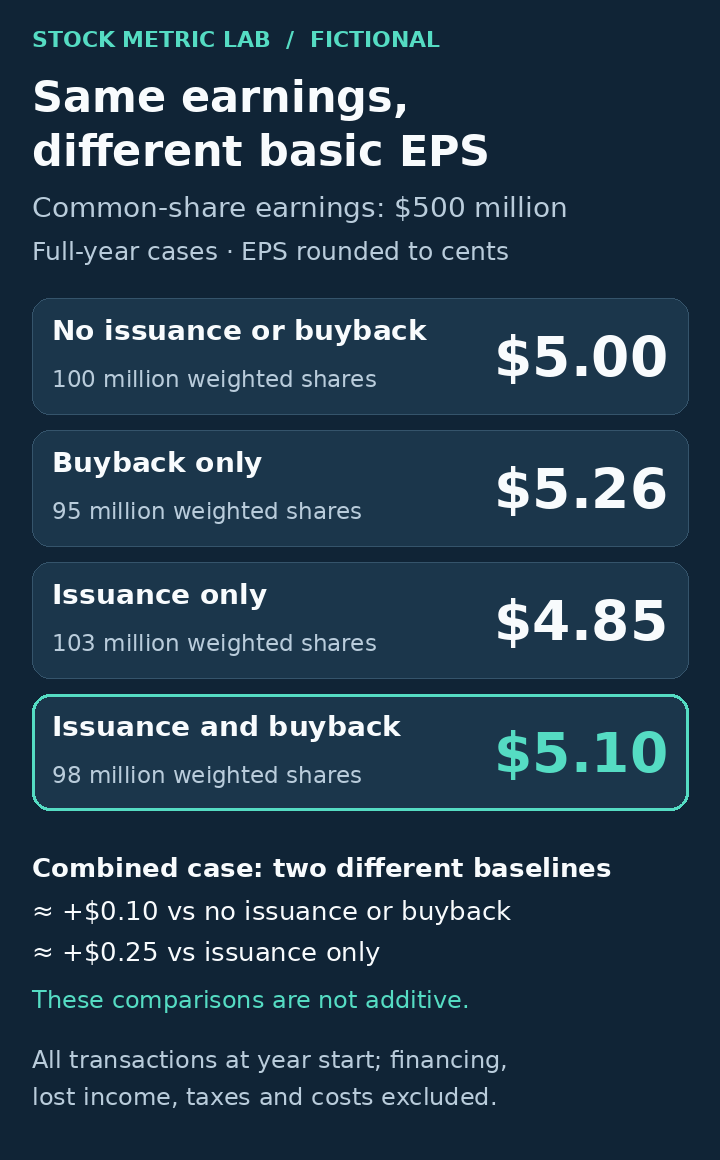
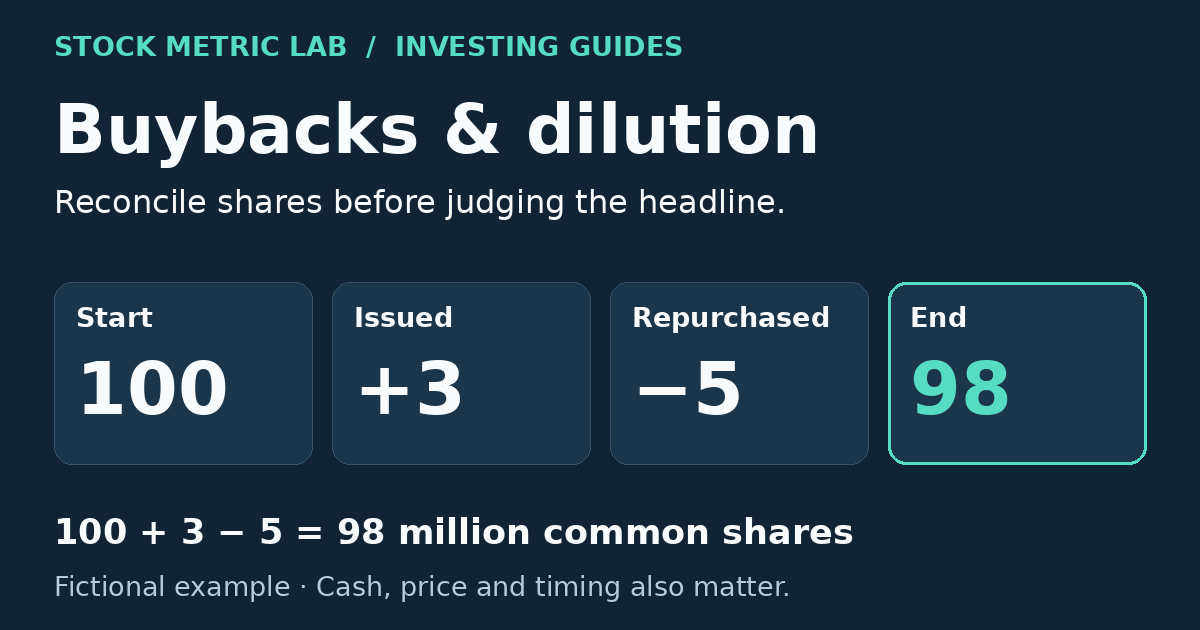
The last row follows 100 million + 3 million − 5 million = 98 million shares, a 2% net reduction from the starting count. Its EPS is about $0.10, or 2.0%, above the original $5.00. Compared with the issuance-only scenario, however, the buyback adds about $0.25 per share. These are different comparisons. Issuance alone is not a scenario in which nothing happened.
Share reconciliation: beginning outstanding shares + shares newly issued or released from treasury − shares repurchased = ending outstanding shares, after separately reconciling splits, conversions, and other relevant changes. Use consistent share classes and units. A dollar amount cannot be subtracted from a number of shares.
Cash reconciliation: compare cash paid for repurchases with cash received from share issuance or option exercise, while keeping related taxes and fees visible. This net cash measure is not the net share reduction. Issuing shares for employee services or an acquisition may bring no cash proceeds, while an option exercise or equity offering may bring cash. More shares do not by themselves prove that value per share fell; consider the cash, services, assets, or debt reduction received.
SBC expense, cash spent on repurchases, actual shares issued, and potential dilution in the EPS note measure different things. Subtracting SBC expense from buyback spending does not produce a share count. Nor should an analyst count the same economic compensation cost twice in a valuation.
Review options, warrants, convertible securities, share-funded acquisitions, and at-the-market offerings. Distinguish actual issuance from instruments that might become shares later. A split changes the scale of shares and per-share figures without itself changing proportional ownership; use a consistent basis as explained in the stock-splits guide.
4 Price matters even when EPS rises
For a separate valuation illustration, assume the original 100 million shares represent intrinsic equity value of $8 billion, including available cash. That makes the assumed value $80 per share before a repurchase. The $8 billion is an input chosen for teaching, not a value derived from the $500 million profit or the quoted share price.
Assume enough surplus cash, no issuance, no tax or transaction costs, and no change in operating value or future earnings when the cash leaves. Under those restrictive assumptions:
Value per remaining share = (Pre-buyback equity value − Cash spent) ÷ Remaining shares.
- Buying 5 million shares at $80 costs $400 million. Remaining value is $7.6 billion across 95 million shares, still $80 per share.
- Buying 5 million shares at $160 costs $800 million. Remaining value is $7.2 billion across 95 million shares, about $75.79 per share.
In the second case, continuing holders started with a 95% interest worth $7.6 billion and end with $7.2 billion. Sellers receive $800 million for a pre-transaction interest assumed worth $400 million. The resulting $400 million transfer is conditional on the model’s assumptions. The spending budget doubled between these cases; this is not a comparison holding cash spending constant.
Both cases still show approximately $5.26 of EPS if annual earnings remain $500 million and all shares are bought at the start of the year. EPS therefore cannot establish whether the price was attractive. In this model, a purchase below the assumed pre-buyback value increases value per remaining share, a purchase at value leaves it unchanged, and a purchase above value reduces it.
Actual intrinsic value is uncertain. Test a range of cash-flow and risk assumptions, the effect of lost liquidity, and competing uses of cash. A price below last year’s market high is not proof of a bargain. As a documented historical policy example, Berkshire Hathaway’s 2025 Form 10-K, Item 5, describes repurchases below conservatively determined intrinsic value, subject to a liquidity constraint and without an obligation to buy. Our Berkshire analysis provides broader company context.
5 Financing can reverse EPS accretion
Cash used for a repurchase cannot simultaneously earn interest, repay debt, or fund another investment. Borrowing adds interest expense and refinancing risk. Even cash described as idle can have liquidity value.
Return to the $400 million start-of-year buyback at $80, leaving 95 million shares. If the cash would otherwise earn 4% after tax for the year, foregone income is $16 million. With everything else unchanged, earnings become $484 million and EPS is about $5.09. At an 8% after-tax earnings cost, earnings become $468 million and EPS is about $4.93, below the original $5.00.
The same arithmetic can illustrate debt financing if the percentage is the full-year after-tax financing cost. Actual tax deductibility, fees, debt terms, and timing can differ. These percentages are fictional assumptions, not borrowing rates or a tax forecast.
For the simplified positive-earnings model, EPS rises only when the earnings lost on the spending are sufficiently small. Here the break-even after-tax rate is $5.00 ÷ $80 = 6.25%. That EPS threshold is not a valuation hurdle or proof that a purchase creates wealth.
Read the cash-flow statement, debt maturities, and management’s explanation together. Cash is fungible, so do not infer a unique funding source from one line. Compare cumulative dividends and buybacks with cash generation, starting liquidity, new borrowing, issuance proceeds, and asset disposals.
A common FCF proxy is operating cash flow minus cash capital expenditure. It is not a universal spending ceiling or proof that all the amount is discretionary. Acquisitions, debt service, other obligations, and necessary future investment may remain. The SEC’s non-GAAP guidance, Question 102.07, warns about this limitation. See free cash flow explained and FCF versus net income for definitions and the treatment of non-cash compensation.
6 Check the applicable rules
United States. Sources checked on November 9, 2026 retain a 1% federal excise tax under section 4501. It generally concerns stock repurchases by publicly traded domestic corporations and specified affiliate acquisitions, with special provisions for certain foreign-company transactions. It is a corporate-level tax, not a universal 1% charge on every investor sale or every foreign issuer’s buyback.
The tax base is determined using fair market values, qualifying issuance netting within the tax year, and applicable exceptions. These are tax rules, not the share reconciliation above. Statutory exceptions include qualifying reorganizations, qualifying retirement-plan contributions, repurchases not exceeding $1 million in aggregate for the tax year, qualifying ordinary-course dealer purchases, RIC/REIT repurchases, and amounts treated as dividends, subject to the relevant conditions. The $1 million rule is not a deduction from every larger program.
Read 26 U.S.C. section 4501 and the IRS Form 7208 instructions. For foreign-company situations, section 4501(d) and the final regulations apply specific affiliate, expatriated-entity, and netting rules. The 2025 final regulations, T.D. 10037 did not adopt the proposed foreign-parent funding rule. Do not treat that proposal as current law. Later February 2026 correcting amendments should also be read where relevant.
Japan. Check the program’s acquisition method, limits, dates, execution reports, and any separate cancellation resolution. JPX describes purchases on the auction market and through ToSTNeT-2 and ToSTNeT-3. Tender offers are another documented route. Cancellation should not be assumed: repurchase and cancellation are distinct decisions, as illustrated by Mitsubishi Corporation’s April 3, 2025 announcement. See the current JPX repurchase-method overview.
Tax treatment can also depend on the transaction and shareholder. Japan’s National Tax Agency guidance No. 1536, dated April 1, 2026, distinguishes specified issuer repurchases from purchases on a financial instruments exchange market for the rule it explains. This is not a claim that market sales are tax-free. Do not infer a personal tax result from the label “buyback,” or apply U.S. rules automatically to a Japanese issuer.
7 A practical announcement checklist
- Identify whether the amount is newly authorized, remaining authorization, or executed purchases, and record its dates and units.
- Reconcile beginning and ending outstanding shares using actual issuance and purchases. Check treasury shares, cancellations, splits, and share classes.
- Separately reconcile the basic and diluted weighted-average EPS denominators and the earnings numerator.
- Calculate spending relative to a clearly dated market value. Label gross or net cash definitions; do not confuse them with net shares.
- Compare purchase prices with a defensible range of value, not just the stock’s historical trading range.
- Check financing, foregone interest, liquidity, obligations, and alternative investments.
- Read compensation disclosures. An EPS-linked target may create incentives worth examining, but the incentive alone does not prove manipulation.
- Check the applicable jurisdiction’s rules and the company-specific transaction terms.
Finish by explaining what changed in the business, what changed in the share count, and what the company paid to produce that change. A smaller denominator is one part of that account.
Frequently asked questions
Is a buyback better than a dividend
A cash dividend distributes cash pro rata to entitled holders. A buyback pays sellers and changes the remaining ownership structure. Price, financing, liquidity, taxes, and alternative investments matter. Neither is inherently superior, and neither guarantees a positive investment return.
Why did a large announcement barely change the share count
Some authorization may remain unused, execution may occur late in the period, or issuance may offset purchases. You may also be comparing different dates, share classes, or basic and diluted measures. Reconcile the filings before assigning a cause.
Do buybacks always raise EPS
No. Fewer weighted shares increase EPS when positive earnings are unchanged, but interest costs, lost income, transaction effects, and timing can alter the result. With an unchanged loss, fewer shares make the loss per share more negative.
Does cancellation create another EPS boost
No. If shares were already held in treasury and excluded from outstanding shares, cancelling them does not reduce the EPS denominator again. Future new issuance remains possible.
Sources and methodology
Calculations use unrounded amounts until final display. The share examples assume transactions at the start of the year except for the explicitly labeled halfway example. They show basic EPS, not a reconstruction of a real company’s diluted EPS. The value example assumes an equity value including cash, then subtracts the cash paid. Financing scenarios are separate assumptions and must not be silently combined with the unchanged-earnings cases.
Official filings and regulatory sources are linked beside the relevant claims. Legal and tax sources were reviewed on November 9, 2026; the U.S. Code page states currency through October 7, 2026, and the NTA page states law as of April 1, 2026. Recheck current law and transaction facts before applying them.
This article provides general financial education, not individualized investment, tax, or legal advice. Investments can lose value.